The saree is one garment, but there are countless ways to wear it. Across India, women have developed regional draping styles that reflect local culture, climate, traditions and everyday life.
Among these, the Nivi saree drape has become one of the most widely recognised and commonly worn styles in modern India.
With its neatly pleated front, pallu falling over the shoulder and relatively structured appearance, the Nivi style has become a familiar sight at weddings, festivals, workplaces and formal occasions. But the story behind this popular drape is more interesting than it may first appear.
What Is the Nivi Saree Drape?
The Nivi style generally involves wrapping the saree around the waist, creating pleats at the front and bringing the pallu over the left shoulder.
The pallu is usually allowed to fall from the shoulder at the back, although it can also be styled in different ways depending on personal preference.
Its structured appearance makes the Nivi drape particularly versatile.
Where Did the Nivi Style Originate?
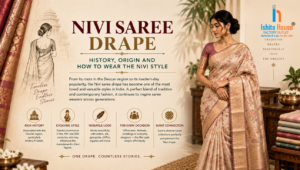
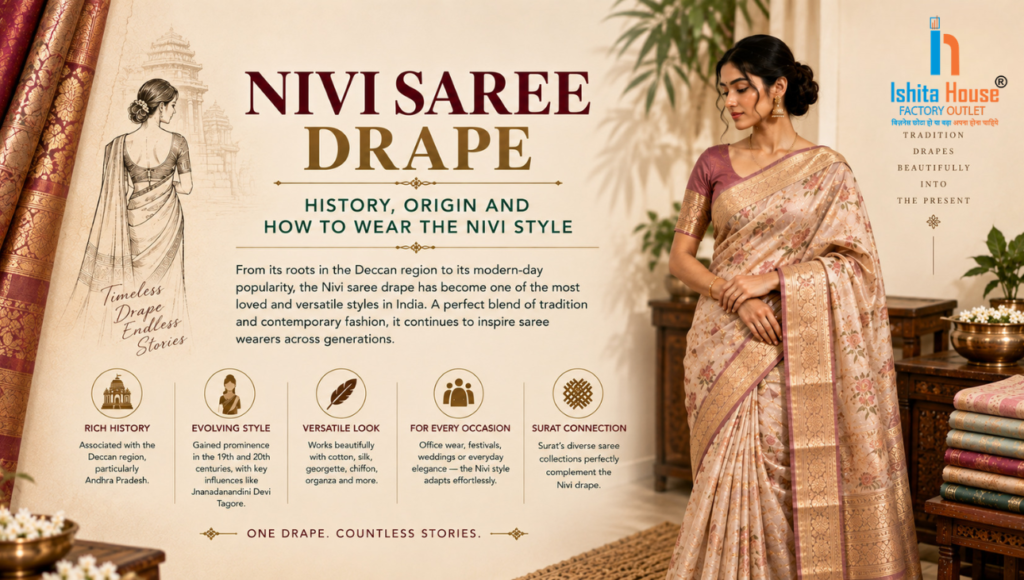
The Nivi drape is generally associated with the Deccan region, particularly Andhra Pradesh.
Like many Indian textile traditions, its exact historical development is complex. Saree draping styles evolved gradually rather than being invented at a single point in time.
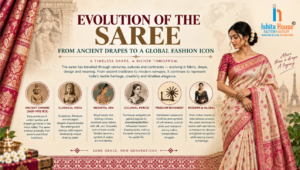
The modern Nivi style became increasingly prominent during the late nineteenth and early twentieth centuries.
Jnanadanandini Devi and the Evolution of Saree Dressing
One important figure frequently discussed in the history of modern Indian saree dressing is Jnanadanandini Devi Tagore, a member of the Tagore family.
She is associated with adapting saree dressing in a way that was more practical for social life outside the home.
The addition of a blouse and petticoat helped create a style that worked with changing social expectations of the period. This contributed to the development and wider acceptance of modern saree dressing.
Why Did Nivi Become So Popular?
One reason for the popularity of the Nivi drape is its versatility. It can be worn with cotton sarees, silk sarees, designer sarees, chiffon, georgette, organza and many other fabrics.
It can also be adapted for different occasions.
A simple cotton saree in the Nivi style can create a professional appearance, while a heavily embellished silk or designer saree can be suitable for weddings and celebrations.
The Nivi Drape in Modern Fashion
The Nivi style has become particularly popular because it works well with contemporary blouses.
Sleeveless blouses, statement sleeves, crop-style blouses, embroidered designs and modern necklines can all be paired with the Nivi drape.
This flexibility has helped the style remain relevant among younger saree wearers.
Surat and the Nivi Saree
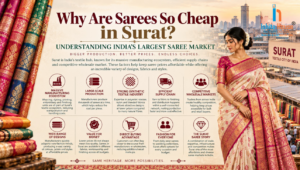
Surat’s extensive saree manufacturing and distribution ecosystem offers a wide variety of sarees that can be worn in the Nivi style.
Printed, embroidered, digital-print, georgette and designer sarees manufactured or distributed through Surat can all be styled using the Nivi method.
This versatility allows the same traditional draping style to work with a wide range of contemporary saree designs.
Nivi for Different Occasions
The same drape can look completely different depending on the saree.
For office wear, women may choose a lightweight cotton or blended saree.
For festivals, colourful printed or silk-look sarees can create a traditional appearance.
For weddings and receptions, heavily embroidered or embellished sarees can transform the same basic drape into a glamorous outfit.
Conclusion
The Nivi saree drape represents the evolution of Indian fashion from regional traditions to a widely adopted modern style.
Its association with Andhra Pradesh, its development alongside changing social practices and its adaptability have helped make it one of India’s most recognisable saree styles.
From traditional cotton sarees to contemporary designer collections, the Nivi drape continues to demonstrate how a traditional garment can adapt to modern life.