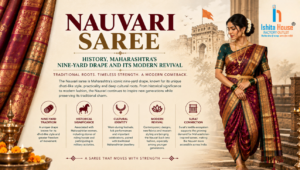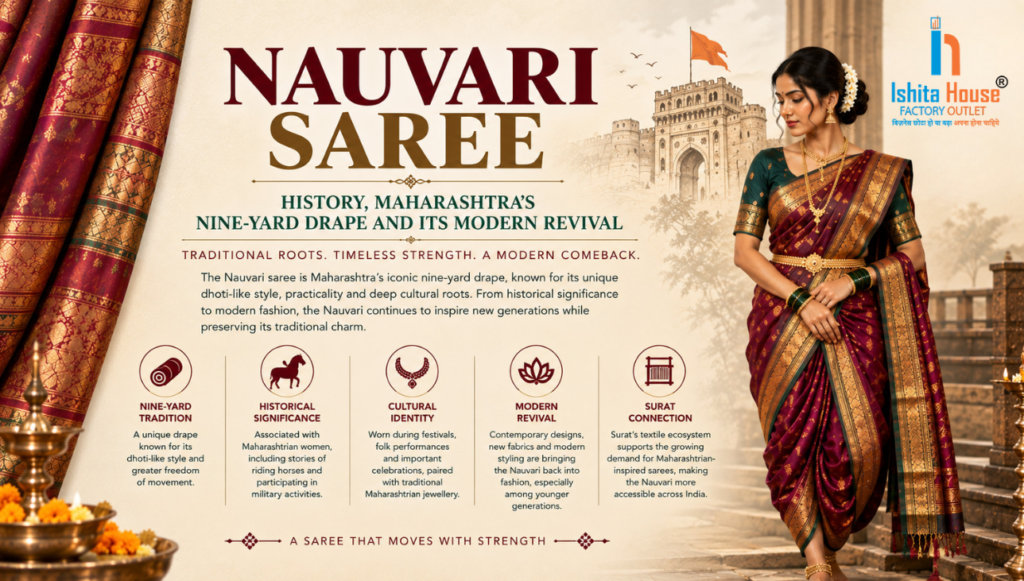
Few saree styles are as distinctive as the Nauvari saree. Traditionally associated with Maharashtra, the nine-yard saree is dramatically different from the conventional saree drape seen across much of India.
Its dhoti-like structure allows greater freedom of movement and reflects the practical side of traditional Indian clothing.
Today, the Nauvari is experiencing renewed interest as designers and younger consumers explore India’s regional textile traditions.
What Does Nauvari Mean?
The word “Nauvari” refers to the nine-yard length traditionally associated with this saree. It is also known as the Kashta or Kasta saree in some contexts.Unlike the conventional saree, the Nauvari is draped between the legs, creating a silhouette that resembles a dhoti.This construction provides greater freedom of movement.
A Saree Designed for Mobility
Traditional clothing often evolved according to the lifestyle of the people wearing it.
The Nauvari’s practical drape allowed women to move more freely while working.Historical accounts and cultural traditions also associate the style with women who participated in physically demanding activities.
Stories of women wearing the Nauvari while riding horses or participating in military activities have contributed to its strong cultural image.
The Traditional Maharashtrian Look
The Nauvari is closely associated with Maharashtrian culture.It can be paired with traditional jewellery, a nath, bangles and other regional accessories.
During festivals and cultural celebrations, women often wear Nauvari sarees to express Maharashtrian heritage.
Nauvari and Maharashtra’s Folk Culture
The saree is frequently seen in folk performances, cultural programmes and traditional celebrations.Its distinctive silhouette makes it immediately recognisable.
For many wearers, the Nauvari represents more than fashion—it represents a connection with Maharashtra’s history and cultural traditions.
The Modern Nauvari Saree
Designers have increasingly experimented with the Nauvari style.Modern versions may use lighter fabrics, contemporary colours and updated blouse designs.Some women choose the style for weddings, cultural events and fashion shoots rather than everyday wear.The drape can also be adapted for easier modern styling.
Surat’s Connection With Nauvari Fashion
Surat has a large textile manufacturing ecosystem that supplies sarees to markets across India.As regional sarees become increasingly popular, Maharashtrian-inspired styles can become part of collections produced or distributed through Surat.
Nauvari and Younger Generations
Social media has played an important role in bringing regional saree styles back into the fashion conversation.Young women increasingly experiment with traditional drapes for weddings, festivals and photoshoots.
The Nauvari’s distinctive appearance makes it particularly suitable for visual fashion content.
Why the Nauvari Remains Relevant
The strength of the Nauvari lies in its combination of cultural identity and practicality.It demonstrates that traditional Indian clothing was not always designed only for appearance. Draping techniques often reflected the everyday activities and environments of the communities that developed them.
The Nauvari saree is one of Maharashtra’s most distinctive traditional garments.Its nine-yard construction and dhoti-like drape provide a unique combination of cultural identity and freedom of movement.As Indian fashion increasingly rediscovers regional traditions, the Nauvari is finding new audiences.
Its journey from traditional Maharashtrian clothing to contemporary fashion demonstrates how India’s saree traditions can evolve without losing their cultural character.
—–
(Meta Description: Discover the history of the Nauvari saree, Maharashtra’s traditional nine-yard drape, its dhoti-like style, cultural significance and modern fashion revival.)