When discussing India’s diverse saree traditions, Assam offers something particularly distinctive. The Mekhela Chador is a traditional two-piece garment that differs structurally from the conventional one-piece saree.
Known for its elegant drape, traditional motifs and connection with Assam’s textile heritage, Mekhela Chador has become increasingly visible in India’s contemporary ethnic fashion market.
What Is Mekhela Chador?
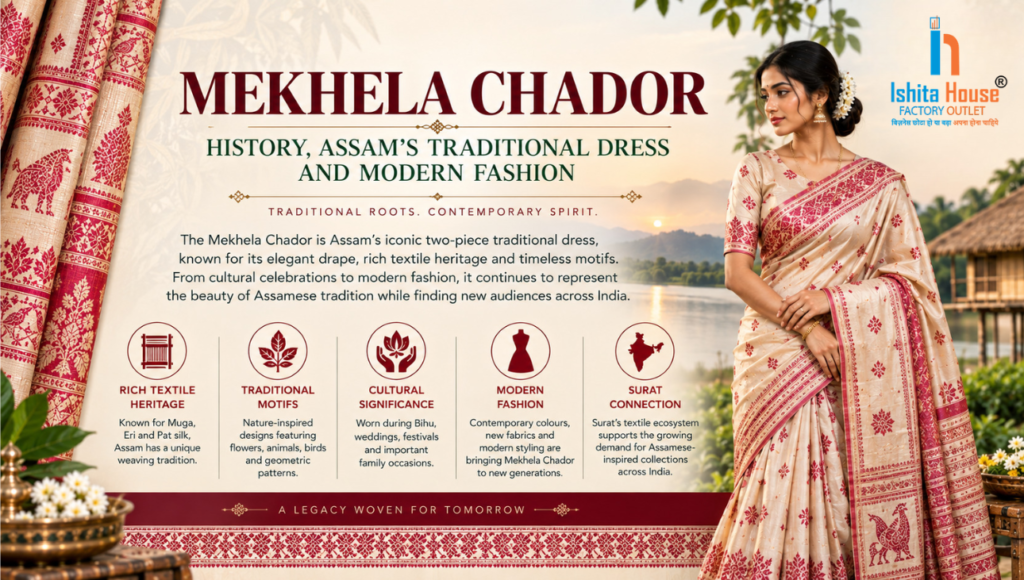
Mekhela Chador consists primarily of two pieces. The mekhela forms the lower portion of the garment and is worn around the waist, while the chador is draped over the upper body.
The two pieces together create an elegant traditional Assamese appearance.
Assam’s Rich Textile Heritage
Assam has a distinctive textile heritage closely connected with silk production and weaving. Muga silk, Eri silk and Pat silk are among the textiles associated with Assam.
Traditional Assamese textiles frequently feature nature-inspired motifs and regional designs. These include flowers, animals, birds and geometric patterns.
The Cultural Importance of Mekhela Chador
Mekhela Chador is strongly connected with Assamese identity. It is worn during festivals, weddings, cultural programmes and important family occasions.
During celebrations such as Bihu, traditional Assamese clothing becomes an important expression of regional culture.
How Is It Different From a Saree?
Although Mekhela Chador is often discussed alongside Indian sarees, it is structurally different.
A conventional saree is generally a single long piece of fabric that is wrapped and draped around the body.
Mekhela Chador consists of separate pieces that are worn together. This difference makes it an important example of India’s extraordinarily diverse approaches to traditional clothing.
Traditional Motifs
Assamese textiles are known for distinctive motifs inspired by the natural environment and cultural traditions.
Traditional patterns can add visual richness without requiring the heavy embellishment commonly found in some contemporary wedding sarees.
The result is an elegant and recognisable style.
Mekhela Chador Enters Contemporary Fashion
Modern designers have introduced new interpretations of Mekhela Chador. Contemporary versions may experiment with colours, fabrics, borders and styling.
Younger women may pair traditional garments with modern jewellery, blouses and accessories.
This allows the garment to retain its cultural identity while becoming part of contemporary fashion.
Surat’s Connection With Assamese Fashion
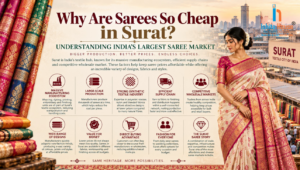
Surat has one of India’s largest textile manufacturing and distribution ecosystems.
The city’s retailers and manufacturers increasingly respond to fashion influences from different parts of India. Assamese-inspired colours, motifs and design elements can therefore influence contemporary textile collections available through wider markets.
The connection is primarily related to modern fashion, design inspiration and distribution rather than the traditional origin of Mekhela Chador.
Preserving Authenticity
As regional styles become popular nationally, it is important to distinguish authentic traditional textiles from commercially inspired products.
A genuine handwoven Assamese silk garment carries a different craft history from a machine-produced garment inspired by Assamese motifs.
Clear descriptions help consumers understand what they are purchasing while respecting the original textile tradition.
Conclusion
The Mekhela Chador is a remarkable example of India’s regional clothing diversity. Its two-piece construction, Assamese textile heritage and distinctive motifs make it different from conventional saree drapes.
As regional fashion becomes increasingly popular across India, Mekhela Chador is finding new audiences while continuing to represent Assam’s cultural identity.
Its connection with modern textile centres such as Surat demonstrates how India’s regional fashion traditions are increasingly becoming part of a national and global fashion conversation.