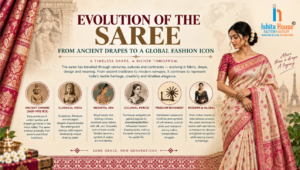
The saree is one of the world’s most enduring garments. Worn across India for centuries, it has continuously changed in fabric, draping style, ornamentation and social meaning while retaining its fundamental identity: a long piece of cloth wrapped and pleated around the body.
Today, the saree is worn not only in India but also on international runways, at weddings, cultural celebrations and global red carpets. Its history is therefore not simply the story of a garment—it is the story of Indian textile heritage.
Ancient Origins of the Saree
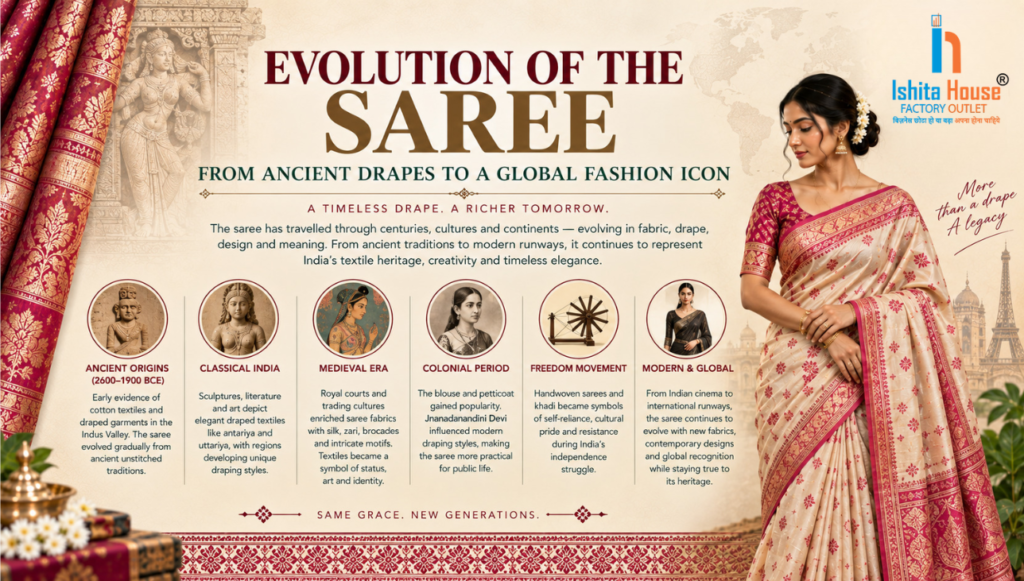
The origins of the saree are generally associated with the long tradition of unstitched garments in the Indian subcontinent. Archaeological evidence from the Indus Valley Civilisation, dating roughly from 2600 to 1900 BCE, demonstrates the use of cotton textiles and sophisticated textile production. However, historians caution that there is no surviving garment that can definitively be identified as a modern saree.
Ancient Indian clothing often consisted of separate lengths of fabric worn around different parts of the body. Literary and artistic sources provide evidence of garments such as the antariya, worn around the lower body, and the uttariya, which could be worn over the shoulders or upper body.
The modern saree therefore did not suddenly appear in ancient India in its present form. Rather, it evolved gradually from several traditions of draped clothing.
The Sanskrit and later literary traditions contain references to women’s clothing and draped textiles, while sculptures and paintings provide important visual evidence. Ancient Indian art frequently depicts women wearing beautifully arranged textiles with elaborate pleats, folds and ornaments.
The Unstitched Tradition
One of the most distinctive characteristics of Indian clothing was the extensive use of unstitched fabric. Unlike many garments that required cutting and sewing, a long piece of cloth could be wrapped, folded and draped in different ways.
This offered considerable flexibility. The same basic textile could be adapted according to region, occupation, climate, community and occasion.
Over centuries, different parts of India developed their own methods of draping. This explains why there is no single traditional way to wear a saree.
From the Nivi drape associated with the Deccan region to the Gujarati Seedha Pallu style, Maharashtra’s Nauvari, Bengal’s Atpoure and Kerala’s traditional drapes, regional saree styles represent India’s extraordinary cultural diversity.
The Medieval Period: Textiles Become Art
During the medieval period, India’s textile traditions became increasingly sophisticated. Royal courts, temples and wealthy trading communities supported skilled weavers and artisans.
The growth of long-distance trade brought new colours, motifs, weaving techniques and aesthetic influences. Persianate court culture, particularly during the Mughal period, contributed to the popularity of elaborate floral patterns, brocades and luxurious textiles.
Zari, involving metallic threads, became particularly important in luxurious Indian textiles. Centres such as Banaras, Gujarat, Paithan and other weaving regions developed distinctive silk and brocade traditions.
The saree increasingly became more than everyday clothing. Fine textiles could communicate wealth, social position, regional identity and occasion.
At the same time, it is important not to view the history of the saree simply through Mughal influence. India’s regional weaving and draping traditions had their own long histories and continued to develop independently alongside courtly influences.
The Evolution of the Blouse
The blouse has a more complicated history than the saree itself.
In many ancient representations, women appear wearing draped garments without a modern stitched blouse. Different communities across India also followed different conventions concerning upper-body clothing.
Stitched upper garments existed in the subcontinent before the colonial period, and forms such as the choli became established in several regions. However, the fitted blouse familiar today became increasingly widespread during the 19th and early 20th centuries.
Colonial society played an important role in changing ideas about dress and public appearance. Victorian notions of modesty influenced elite Indian society, while Indian women and communities simultaneously adapted clothing according to their own cultural and social circumstances.
Thus, the modern saree ensemble—saree, blouse and petticoat—is the result of several historical developments rather than a single invention.
Jnanadanandini Devi and the Modern Saree
One of the most important figures associated with the transformation of saree draping in the 19th century is Jnanadanandini Devi, a member of the Tagore family.
She is widely credited with popularising a practical style of wearing the saree that incorporated a blouse and petticoat and allowed the pallu to pass over the shoulder in a manner suitable for public and social settings.
The style became associated with the emerging educated middle and upper classes of Bengal and subsequently influenced modern saree dressing.
It is sometimes described as the origin of the Nivi style, although historians generally distinguish between the Bengali innovations associated with Jnanadanandini Devi and the Nivi drape that became strongly associated with the Deccan and later Andhra region.
The modern saree, therefore, emerged through a process of regional exchange and adaptation rather than from one single source.
Saree, Swadeshi and India’s Freedom Movement
During the 19th and 20th centuries, the saree acquired another powerful meaning: national identity.
British industrial textiles had a major impact on India’s traditional textile economy. The decline of many indigenous weaving industries became an important political and economic concern.
During the Swadeshi movement and India’s independence struggle, hand-spun and handwoven textiles became symbols of self-reliance. Khadi, promoted prominently by Mahatma Gandhi, represented resistance to colonial economic structures and support for Indian production.
The saree consequently became both clothing and a statement of cultural identity.
The Saree in Post-Independence India
After independence in 1947, the saree became closely associated with Indian public life. Women wore it in politics, education, business, cinema and formal occasions.
Indian cinema played an especially important role in transforming saree fashion. Actresses introduced new blouse designs, fabrics, colours and draping techniques to millions of viewers.
Traditional handlooms such as Banarasi, Kanjeevaram, Chanderi, Paithani, Bandhani, Patola and Sambalpuri gained renewed visibility alongside increasingly popular mill-made fabrics.
The saree could therefore be simultaneously traditional and modern.
The Saree in Contemporary Fashion
In the 21st century, the evolution of the saree has entered another phase.
Indian designers have experimented with organza, chiffon, georgette, silk, linen and contemporary blends. Blouses may now feature dramatic sleeves, crop-top silhouettes, jackets, corsets and unconventional cuts.
Ready-to-wear sarees have also emerged for consumers seeking the visual appeal of a saree with easier draping.
International celebrities and Indian designers have further introduced the saree to global fashion audiences. At the same time, India’s handloom revival has encouraged renewed interest in traditional weaving techniques and regional textiles.
The Future of the Saree
The remarkable strength of the saree lies in its ability to change without losing its essential identity.
It has moved from ancient draped textiles to regional handlooms, from royal wardrobes to nationalist symbolism, and from cinema fashion to international couture. Yet the basic concept—a length of fabric transformed through draping—remains remarkably constant.
The evolution of the saree is therefore not a simple journey from old to new. It is a continuous dialogue between tradition and innovation.
As Indian designers, weavers and younger generations reinterpret the garment, the saree continues to prove that heritage and contemporary fashion can coexist.
More than five millennia of textile history have given the saree something few garments possess: the ability to represent culture, craftsmanship, identity and individual expression at the same time.
From the ancient draped garment to the modern designer saree, its journey remains one of India’s most fascinating stories in fashion history.