When people think of affordable sarees in India, Surat is one of the first places that comes to mind. Known as the textile city of India, Surat has built a massive ecosystem around the manufacturing, processing, designing, wholesaling and distribution of sarees.
From budget-friendly daily-wear sarees to heavily embellished wedding collections, Surat offers an extraordinary range of prices.
But why are sarees so cheap in Surat?
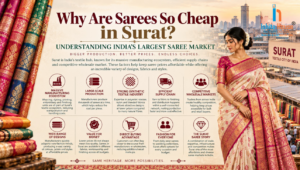
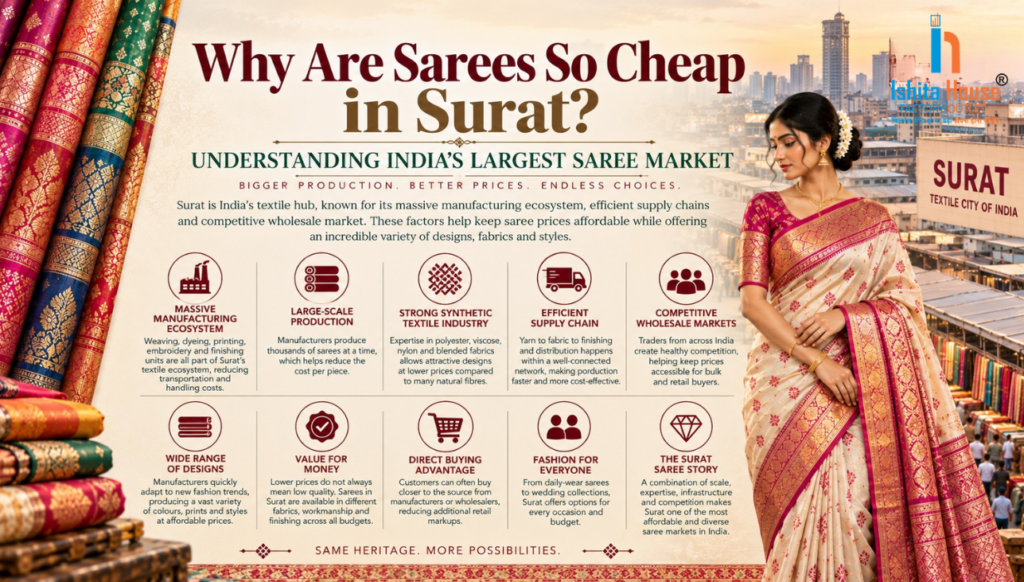
The answer is not simply that the sarees are of lower quality. Surat’s relatively low prices are largely the result of its enormous production scale, specialised textile infrastructure, efficient supply chains, competitive manufacturing and strong wholesale market.
Surat’s Massive Textile Manufacturing Ecosystem
One of the biggest reasons behind affordable sarees in Surat is the city’s extensive textile ecosystem.
Surat has developed specialised clusters for synthetic fabrics, weaving, dyeing, printing, embroidery, finishing and garment manufacturing.
Instead of sending materials to different parts of the country for every stage of production, many processes can be completed within the same broader textile ecosystem.
This concentration reduces transportation, handling and distribution costs.
For saree manufacturers and wholesalers, having suppliers, processors, designers, labour and markets close to each other makes production faster and more efficient.
Large-Scale Production Reduces Costs
Surat produces sarees on a very large scale. Manufacturers often produce thousands of pieces using similar designs, fabrics and production processes.
When production volumes are high, the fixed cost of designing, setting up machines and processing materials can be distributed across a much larger number of sarees.
This is an important reason why a saree manufactured in Surat can sometimes be significantly cheaper than a similar-looking saree produced in smaller quantities elsewhere.
The principle is simple: higher production volume can reduce the cost per piece.
Surat’s Strong Synthetic Textile Industry
Another major factor is Surat’s expertise in synthetic fabrics.
The city is particularly well known for the production and processing of fabrics such as polyester, viscose, nylon and blends.
These materials can be considerably less expensive than many premium natural fibres such as pure silk.
Synthetic fabrics can also be engineered to imitate the appearance and texture of more expensive textiles.
This allows manufacturers to produce sarees that look attractive and fashionable while keeping the retail price accessible to a broad consumer market.
An Efficient Supply Chain
Surat’s textile industry has developed an extensive supply chain connecting yarn manufacturers, weavers, dyers, printers, embroidery units, designers, saree manufacturers, wholesalers and retailers.
This interconnected network is one of the city’s biggest competitive advantages.
A saree can move through several stages—from yarn to fabric, printing or dyeing, embroidery, finishing, packaging and wholesale distribution—within a highly developed regional ecosystem.
Fewer logistical complications can translate into lower costs and faster delivery.
Competitive Wholesale Markets
Surat is also one of India’s major wholesale destinations for sarees and dress materials.
Traders from different parts of India regularly source textiles from the city. This creates intense competition among manufacturers and wholesalers.
Competition encourages businesses to offer different combinations of price, design, quality and quantity.
For buyers purchasing in bulk, manufacturers may also offer substantially different prices from those available at retail stores because wholesale transactions involve larger quantities and fewer retail-level costs.
Designs Change Quickly
Fashion changes rapidly in the Indian saree market. New colours, prints, embroidery patterns and blouse designs appear regularly.
Surat’s manufacturing ecosystem is particularly well suited to this fast-moving market.
Manufacturers can quickly adapt designs to changing consumer preferences and produce large quantities when a particular style becomes popular.
This combination of speed, scale and design flexibility helps Surat compete strongly in the affordable and mid-market saree segments.
Cheap Does Not Always Mean Low Quality
One of the biggest misconceptions