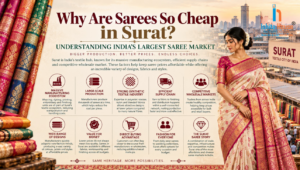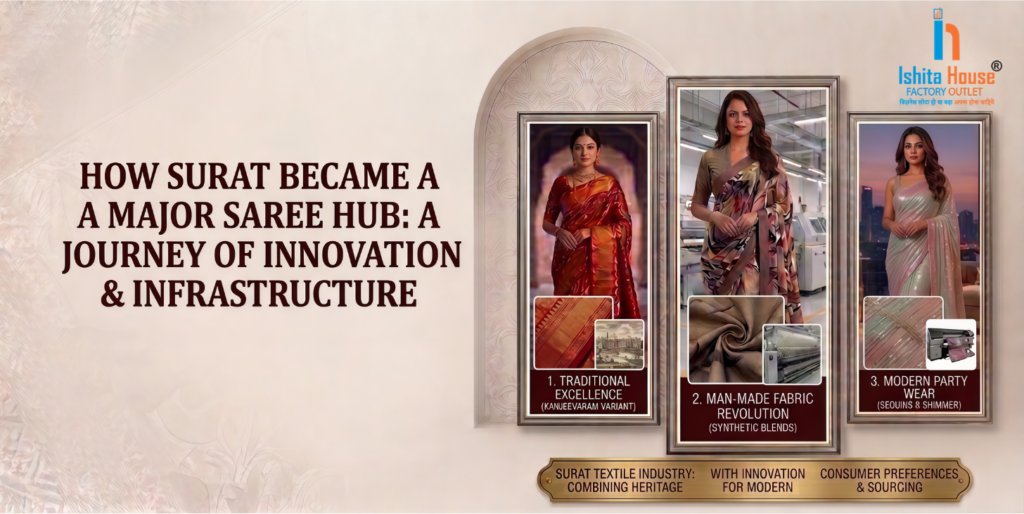
When people search for saree manufacturers in Surat, they are looking at the result of a long textile and commercial journey. Surat’s position in India’s saree industry was not created overnight. It developed through the city’s historic trading connections, textile expertise, manufacturing infrastructure and ability to adopt new technologies.
Today, Surat is one of the most recognised textile centres in India, particularly for synthetic fabrics, sarees, dress materials and fashion textiles.
Surat’s Strategic Commercial Location
Surat’s location on the western coast of India played an important role in its historical development.
The city became a significant trading centre with commercial connections extending across India and overseas. Textile products were among the commodities associated with these trade networks.
This commercial environment encouraged the growth of merchants, traders and textile-related businesses.
Textile Skills and Manufacturing
As the textile economy expanded, specialised activities developed around fabric production and processing.
Different businesses began focusing on weaving, dyeing, printing, embroidery, finishing and trading.
The availability of multiple textile services within the same region created an efficient ecosystem.
For saree manufacturers, this meant that different stages of production could be coordinated relatively easily.
The Growth of Man-Made Fabrics
A major transformation came with the increasing importance of man-made and synthetic fabrics.
Synthetic materials offered manufacturers the ability to produce large quantities of fabric with consistent characteristics. They could also be used to create affordable products for a mass market.
This became particularly important as Indian consumers increasingly looked for sarees that were attractive, lightweight, affordable and easy to maintain.
Surat’s manufacturers responded to this demand by developing extensive collections of synthetic and blended-fabric sarees.
Printing and Design Innovation
Saree fashion depends heavily on design.
The development of modern printing technologies allowed manufacturers to create a much wider variety of designs.
Floral prints, geometric patterns, abstract artwork and traditional motifs could be reproduced in different colour combinations.
The introduction of digital printing further expanded creative possibilities.
Today, manufacturers can respond quickly to changing fashion trends, which is particularly important in the fast-moving fashion market.
The Importance of Embroidery
Embroidery and embellishment have also contributed to Surat’s reputation.
Sequin work, decorative borders, threadwork and other embellishments are widely used in contemporary saree collections.
These techniques allow manufacturers to create products for weddings, festivals, receptions and parties.
Surat as a Wholesale Destination
Manufacturing is only one part of Surat’s textile success.
The city also developed an extensive wholesale and distribution network.
Retailers from different parts of India can source sarees through Surat’s large network of manufacturers, wholesalers and distributors.
This has strengthened Surat’s position as a major saree sourcing destination.
Adapting to Changing Consumer Preferences
One of Surat’s greatest strengths has been its ability to adapt.
Fashion preferences change continuously. Customers may move from heavy traditional sarees to lightweight designs, from conventional prints to digital artwork, or from bright colours to pastel palettes.
Surat’s manufacturing ecosystem allows businesses to respond to these changes relatively quickly.
Surat’s Saree Industry Today
Modern saree manufacturers in Surat offer an extensive range of products.
These include:
- Designer sarees
- Digital print sarees
- Party wear sarees
- Wedding sarees
- Organza sarees
- Georgette sarees
- Chiffon sarees
- Embroidered sarees
- Sequin work sarees
- Festive collections
The industry serves both domestic retailers and international buyers.
Conclusion
The development of Surat as a major saree manufacturing centre is the result of several factors working together: commercial history, textile expertise, manufacturing infrastructure, technological adoption and strong distribution networks.
The city has continuously adapted to changing consumer preferences.
From traditional textile trading to modern printing and large-scale manufacturing, Surat’s journey demonstrates how India’s textile industry can combine heritage with innovation.
For retailers and fashion businesses, this makes Surat an important destination for sourcing sarees and other textile products.