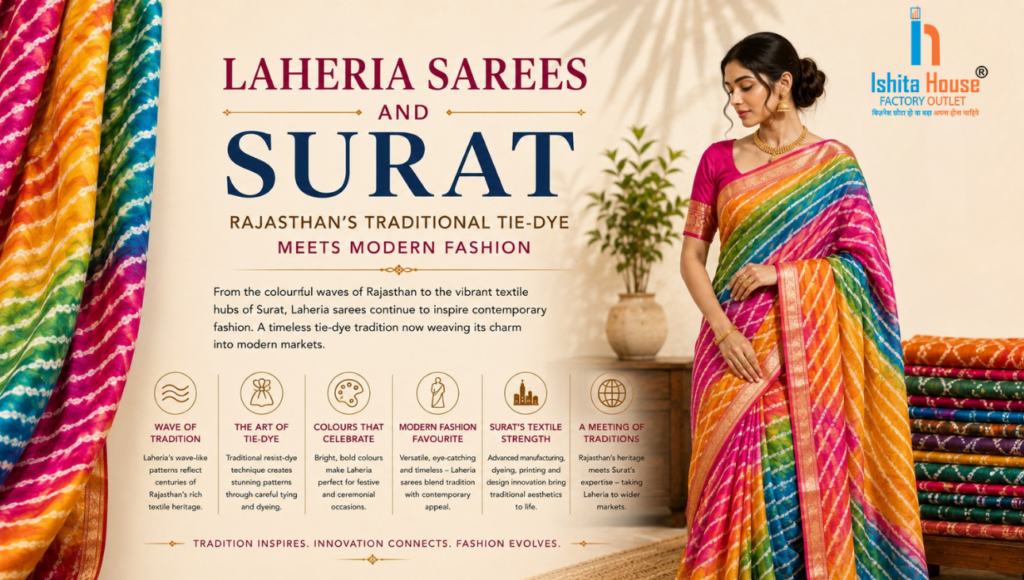
Surat: Few Indian textile traditions are as visually distinctive as Laheria. Associated particularly with Rajasthan, Laheria is recognised for its characteristic wave-like patterns created through a traditional resist-dyeing technique.
Traditionally associated with colourful turbans, odhnis and sarees, Laheria has evolved over generations while continuing to influence Indian ethnic fashion.
Today, the distinctive Laheria aesthetic is also reaching wider markets, including Surat, one of India’s leading textile manufacturing and distribution centres.
What Is Laheria?
The word Laheria is associated with the appearance of waves or flowing lines. The traditional technique involves carefully folding, tying or binding fabric before dyeing it.
The resist areas remain protected while the exposed portions absorb the dye, producing characteristic striped or wave-like patterns. The result is a colourful textile with a distinctive visual identity.
Laheria and Rajasthan’s Textile Heritage
Laheria is deeply connected with Rajasthan’s traditional textile culture. Bright colours have traditionally been an important feature of Rajasthan’s textiles, and Laheria often appears in vibrant combinations.
The technique is particularly associated with colours and patterns suitable for festive and ceremonial clothing. Its visual appeal has allowed it to remain relevant even as fashion has changed.
Why Laheria Works in Modern Saree Fashion
The strongest feature of Laheria is its pattern. The flowing lines can create an attractive visual effect when draped around the body.
Modern designers and manufacturers can experiment with colour combinations, pattern density and fabric choices. This makes Laheria-inspired sarees suitable for customers looking for colourful ethnic fashion with a distinctive regional character.
Surat’s Textile Connection
Surat has developed a vast textile ecosystem covering manufacturing, processing, printing, dyeing, embroidery and wholesale distribution.
The city is known for producing sarees for a wide range of markets and price segments. As regional textile trends become more popular, traditional patterns such as Laheria can inspire contemporary collections.
The connection is therefore one of design influence and modern textile commerce, rather than geographical origin.
Bright Colours Return to Fashion
Fashion trends frequently move between minimalism and bold colours. While pastel shades have become popular in contemporary fashion, colourful ethnic wear continues to have strong demand during weddings, festivals and celebrations.
Laheria’s vibrant aesthetic fits naturally into this market. Pink, yellow, orange, green, blue and other bright combinations can create a festive appearance.
Surat’s Ability to Adapt
Surat’s manufacturing ecosystem allows businesses to respond rapidly to changing fashion trends. Manufacturers can experiment with fabrics, colours, printing techniques and embellishments.
A traditional visual concept such as Laheria can therefore be adapted for contemporary customers while retaining its recognisable wave-like aesthetic.
A Meeting of Regional Textile Traditions
The connection between Rajasthan and Surat demonstrates the diversity of India’s textile industry.
Rajasthan contributes distinctive traditional techniques and visual language, while Surat contributes large-scale manufacturing, processing and distribution capabilities.
Together, these trends show how regional Indian fashion can travel across state boundaries and find new audiences.
Conclusion
Laheria is an important part of Rajasthan’s colourful textile heritage, while Surat represents India’s modern textile manufacturing and fashion ecosystem.
The growing interest in Laheria-inspired sarees shows that traditional Indian textile patterns continue to influence contemporary fashion.
As consumers increasingly explore regional designs, the future of the saree may see even more combinations of traditional inspiration, modern fabrics, new colours and contemporary manufacturing.