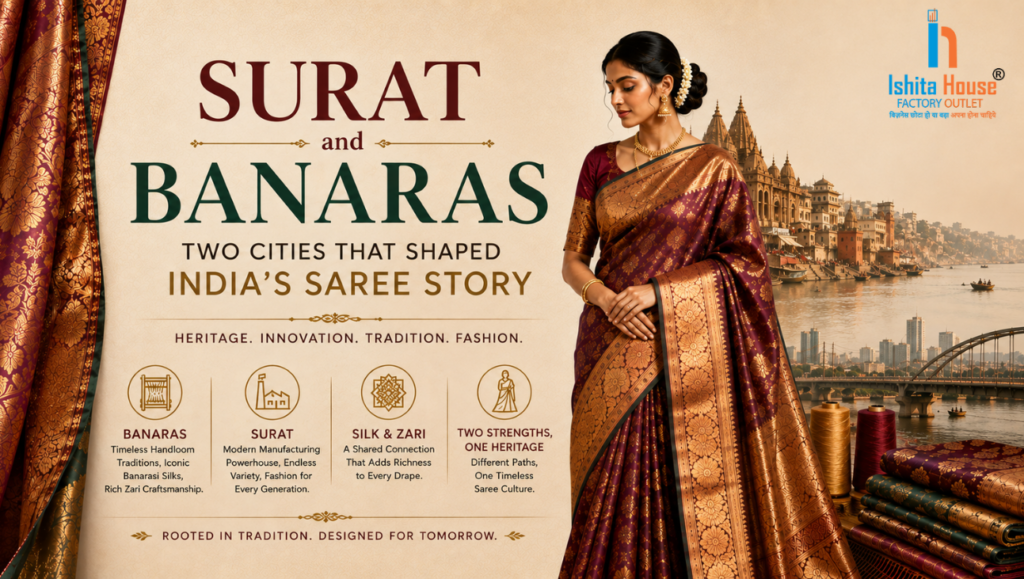
When discussing India’s saree heritage, two cities stand out for very different reasons: Surat and Banaras. Banaras, now officially known as Varanasi, is internationally recognised for its rich handloom traditions and iconic Banarasi silk sarees. Surat, on the other hand, has developed into one of India’s largest modern textile and saree manufacturing centres.
The two cities represent two different but complementary sides of India’s saree story—heritage and innovation, craftsmanship and scale, tradition and modern fashion.
Banaras: The Home of the Iconic Banarasi Saree
Banaras has a centuries-old association with silk weaving and handloom traditions. The Banarasi saree is particularly famous for its silk fabric, intricate motifs and zari work.
Traditional Banarasi sarees often feature motifs inspired by flowers, leaves, nature and Mughal-influenced design traditions. The use of metallic zari gives many Banarasi sarees their distinctive richness.
For generations, Banarasi sarees have been associated with weddings, bridal wardrobes and important celebrations.
Their appeal comes not simply from their appearance but from the craftsmanship and weaving traditions behind them.
Surat: The Modern Textile Powerhouse
Surat’s connection with sarees is different.
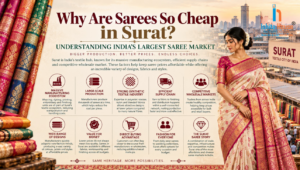
The city has developed a massive textile ecosystem involving weaving, fabric processing, dyeing, printing, embroidery, finishing, wholesale and distribution.
Today, Surat sarees are known for their extraordinary variety. Manufacturers produce everything from printed and digital-print sarees to georgette, organza, chiffon, embroidered, sequin and designer collections.
Surat has become particularly important for retailers looking for fashionable sarees at different price points.
Silk and Zari: A Common Connection
Although Surat and Banaras developed different textile identities, there is an interesting connection through silk and zari.
Banaras is renowned for its traditional silk weaving and zari craftsmanship. Surat has also developed a strong association with zari and decorative textile work.
Zari has historically been an important element of Indian festive clothing because it adds richness and visual appeal.
This shared connection demonstrates how different textile centres have contributed to India’s larger saree culture.
Handloom Tradition vs Modern Manufacturing
One of the clearest differences between the two cities is their production ecosystem.
Banarasi sarees are strongly associated with handloom weaving and traditional craftsmanship. The skill of the weaver plays a central role in creating the saree.
Surat’s modern saree industry is more closely associated with large-scale textile manufacturing, synthetic and blended fabrics, printing, processing and machine-based production.
This does not make one better than the other. They serve different consumer requirements.
Traditional Banarasi Sarees
Banarasi sarees are often selected when customers want:
- Traditional craftsmanship
- Silk
- Rich zari work
- Classic motifs
- Bridal and wedding fashion
- Heritage appeal
They are particularly valued for special occasions and ceremonial dressing.
Modern Surat Sarees
Surat sarees can appeal to customers looking for:
- Lightweight fabrics
- Contemporary designs
- Digital prints
- Floral patterns
- Sequin work
- Designer styles
- Party wear
- Affordable fashion
- Large design variety
This makes Surat particularly important to modern retail and fashion businesses.
Surat and Banaras Complement Each Other
It would be misleading to present Surat and Banaras simply as competitors.
They represent different strengths within India’s enormous saree ecosystem.
Banaras preserves a rich handloom and silk tradition, while Surat demonstrates how textile manufacturing can respond rapidly to modern fashion and mass-market demand.
A customer may choose a Banarasi saree for a traditional wedding and a Surat designer saree for a reception or party.
Both can have a place in the same wardrobe.
What Modern Saree Fashion Can Learn From Both
The future of Indian saree fashion may increasingly involve combining traditional aesthetics with modern technology.
Traditional motifs can be recreated through contemporary printing. Modern fabrics can be used to reinterpret classic designs. Zari-inspired borders can appear on lightweight fabrics, while traditional colour combinations can be adapted for younger consumers.
Surat’s manufacturing capabilities and Banaras’s heritage craftsmanship offer complementary possibilities.
Why Both Cities Matter to India’s Saree Industry
India’s saree industry is not built around one city or one production method.
Different textile centres have developed their own identities.
Banaras represents heritage, handloom and silk craftsmanship.
Surat represents manufacturing scale, textile processing, design variety and rapid fashion adaptation.
Together, they demonstrate the remarkable diversity of Indian saree culture.
Conclusion: Two Cities, One Timeless Garment
The story of Surat and Banaras sarees is ultimately not about choosing one city over the other.
It is about understanding two different dimensions of India’s textile heritage.
Banaras keeps the traditions of handwoven silk and zari alive, while Surat brings innovation, variety and modern manufacturing to the saree market.
One is deeply rooted in heritage. The other is constantly looking toward the future.
And the saree continues to connect both worlds—proving that a garment with centuries of history can keep reinventing itself for every new generation.